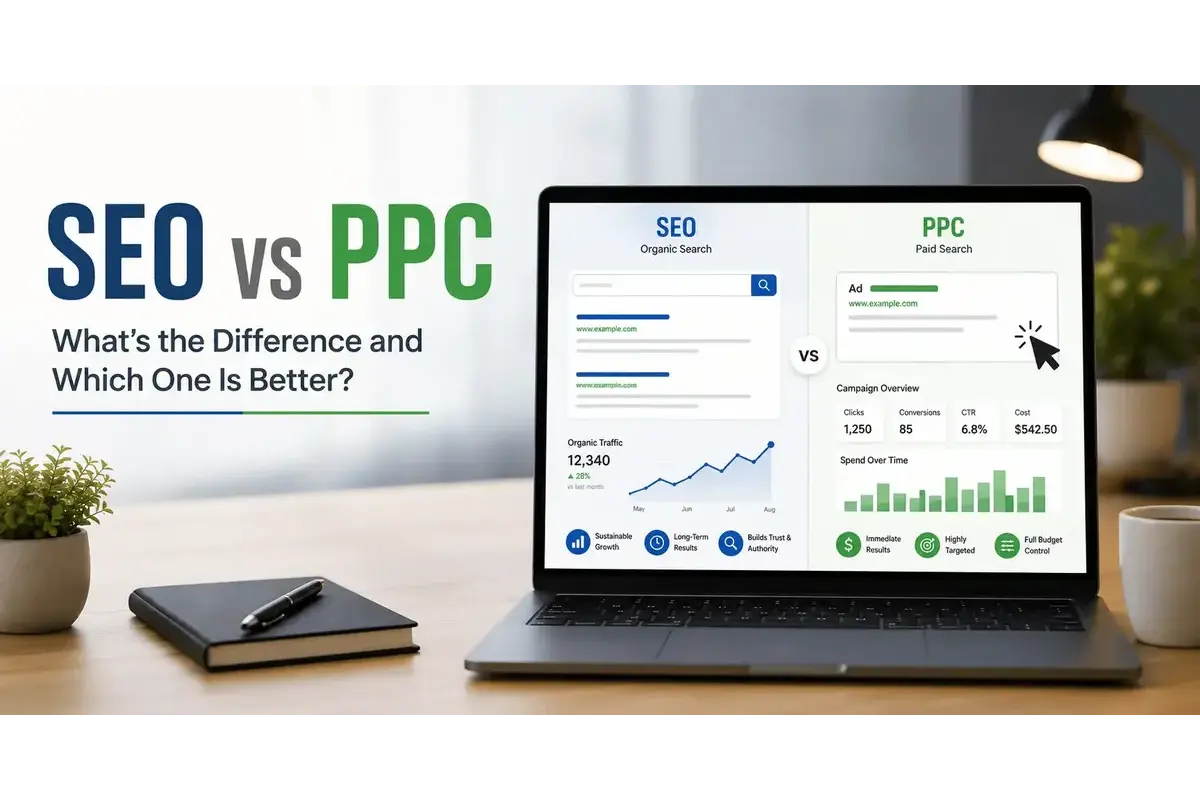
What Is SEO and PPC Marketing?
Before comparing the two channels, it helps to understand what is SEO and PPC marketing.
SEO, or search engine optimization, is the process of improving a website’s visibility in organic search results. This can involve technical SEO, content creation, keyword targeting, internal linking, digital PR, authority building and improving the overall quality of a website.
PPC, or pay-per-click advertising, is a paid marketing model where advertisers bid to display ads for specific searches, audiences or placements. In search advertising, businesses typically pay when someone clicks their ad.
The main difference is straightforward:
SEO focuses on earning organic visibility.
PPC focuses on purchasing visibility through advertising.
Both channels aim to connect businesses with users who are actively searching for relevant products, services or information.
At Turnalar, SEO and paid acquisition can be evaluated as complementary growth channels rather than completely separate strategies.
Difference Between SEO and PPC
The biggest difference between SEO and PPC is how visibility is achieved.
With SEO, a website earns rankings organically by demonstrating relevance, authority and usability. Results usually take time to build, but strong rankings can continue generating traffic without paying for every individual click.
With PPC, visibility can be created much faster by launching advertising campaigns. However, traffic generally depends on continued ad spend.
Factor | SEO | PPC |
Traffic source | Organic search | Paid advertising |
Cost per click | No direct payment for each click | Advertiser pays for clicks |
Speed | Usually gradual | Can generate traffic quickly |
Long-term value | Can compound over time | Depends on ongoing budget |
Position control | Limited | Greater control through bidding |
Targeting | Search intent and content focused | Keyword, audience, device, location and more |
Testing | Usually slower | Faster |
Sustainability | Can continue after initial investment | Usually stops when spend stops |
This is why the PPC versus SEO comparison should focus on business objectives rather than trying to identify one universally better channel.
SEO vs PPC: Which Is Better?
One of the most common questions businesses ask is SEO vs PPC: which is better?
There is no single answer.
SEO may be better when your priority is building sustainable organic visibility and reducing long-term dependence on paid traffic.
PPC may be better when your priority is generating traffic quickly, testing offers or reaching highly specific audiences.
For many businesses, however, the strongest strategy is not SEO or PPC. It is SEO and PPC working together.
SEO can build long-term visibility while PPC supports immediate acquisition, campaign testing and high-intent commercial searches.
SEO Versus PPC: When Should You Choose SEO?
SEO is particularly valuable when long-term organic growth is the main objective.
It may be a strong choice if you want to:
Build sustainable search visibility
Increase non-branded organic traffic
Target informational and commercial searches
Create long-term content assets
Reduce dependence on paid advertising
Increase visibility across a large number of keywords
Strengthen brand authority in search
SEO can be especially valuable for businesses operating in markets where customers conduct extensive research before making a decision.
For example, a software company may create commercial landing pages alongside educational guides that answer early-stage customer questions. Over time, this allows the website to attract users across different stages of the buying journey.
Modern organic visibility also extends beyond traditional Google rankings. Search behavior is increasingly influenced by AI-powered search experiences and generative platforms. Businesses that want to strengthen both traditional search visibility and their presence across emerging AI discovery environments can explore Turnalar's SEO & GEO services.
PPC Versus SEO: When Should You Choose PPC?
PPC is particularly useful when speed, control and testing are priorities.
It may be the stronger option if you need to:
Generate traffic immediately
Promote a new product or service
Test new landing pages
Target high-value commercial keywords
Control geographical targeting
Reach specific audience segments
Run limited-time campaigns
Measure conversion performance quickly
PPC also allows businesses to adjust budgets, bids and targeting based on performance.
If a campaign produces profitable results, spending can be increased. If it underperforms, targeting, landing pages or ad messaging can be changed relatively quickly.
For businesses looking to manage paid acquisition as part of a broader growth strategy, Turnalar's Performance Marketing services focus on measurable campaign performance across paid channels.
PPC vs Organic Search: What’s the Difference?
The PPC vs organic search comparison is important because both channels can appear on the same search engine results page.
Paid results are advertisements. Organic results are listings selected by the search engine's ranking systems.
Organic visibility depends on factors such as relevance, content quality, technical performance, authority and search intent.
Paid visibility depends on campaign settings, bidding, competition, ad quality, targeting and budget.
For businesses, this creates two separate opportunities to appear for the same search.
A company might rank organically for a keyword while also running a paid search ad for the same query.
This can increase overall search visibility, particularly for commercially valuable keywords.
Organic SEO vs PPC: Which Delivers Better Long-Term Value?
When comparing organic SEO vs PPC, long-term value is one of the biggest differences.
PPC produces traffic while the campaign is active and funded. Once spending stops, paid visibility generally stops as well.
SEO works differently.
A page that reaches strong organic rankings may continue attracting visitors over a long period, provided that the content remains competitive, useful and technically accessible.
This does not mean SEO is free.
SEO requires investment in areas such as:
Strategy
Content
Technical optimization
Digital PR
Website development
Analytics
Ongoing optimization
However, the cost structure is different because businesses are not paying a search engine for each organic click.
For this reason, SEO can create compounding value when strong rankings and topical authority are maintained.
How Is Ranking Different When Comparing PPC vs SEO?
Another important question is how is ranking different when comparing PPC vs SEO?
Organic rankings are determined by search engine ranking systems.
A business cannot simply pay Google to improve its organic position. Instead, it needs to demonstrate that its pages are relevant, useful and sufficiently authoritative for the queries being targeted.
PPC rankings operate differently.
Paid search visibility may be influenced by factors such as:
Bid amount
Ad relevance
Expected click-through rate
Landing page experience
Competition
Campaign settings
Ad quality
This means advertisers have more direct control over PPC visibility.
SEO rankings, on the other hand, require businesses to compete organically through content quality, technical performance, authority and user relevance.
SEO vs PPC Click-Through Rates
SEO vs PPC click-through rates can vary significantly depending on the type of search, the position of the result and the intent behind the query.
Users may prefer organic results when looking for educational content, comparisons or detailed research.
Paid search can be especially useful for high-intent commercial queries where users are actively looking to buy, request a quote or contact a provider.
For example, a search such as:
“how does PPC work”
has predominantly informational intent.
A query such as:
“PPC agency”
is much closer to a commercial decision.
This is why click-through rate should not be evaluated in isolation.
The quality and commercial value of the traffic matter just as much as the number of clicks.
A PPC campaign with fewer clicks but a strong conversion rate may generate significantly more business value than an organic page attracting a large amount of low-intent informational traffic.
Difference Between PPC vs Organic Channels
The difference between PPC vs organic channels extends beyond how traffic is acquired.
Organic search is often strongest when businesses want to build:
Long-term visibility
Topical authority
Brand recognition
Informational traffic
Sustainable search market share
PPC is often strongest when businesses want:
Immediate visibility
Precise targeting
Fast campaign testing
Predictable budget control
Short-term acquisition
Direct commercial targeting
Organic channels can take longer to scale but may create compounding value.
Paid channels can scale faster but generally require continued investment.
Understanding this distinction helps businesses decide how to distribute resources across acquisition channels.
SEO vs PPC for Keyword Targeting
SEO and PPC can target many of the same searches, but the strategy is different.
With PPC, marketers can create campaigns around specific keywords and adjust bids based on commercial value.
If one keyword generates high-value conversions, the advertiser can increase investment in that term or build additional campaigns around related queries.
SEO requires a broader approach.
A website may target a primary commercial keyword while creating supporting pages around related questions, comparisons and informational searches.
For example, an agency targeting a commercial term such as “PPC management” might also create content around:
PPC strategy
PPC campaign optimization
Google Ads management
SEO vs PPC
How PPC works
PPC costs
PPC reporting
This creates broader topical coverage while attracting users at different stages of the customer journey.
SEO vs PPC for Conversion Intent
Not all search traffic has the same commercial value.
Someone searching “what is SEO and PPC” is likely at an earlier stage of the research process than someone searching for an SEO agency or PPC management service.
SEO is particularly effective at covering multiple stages of the funnel because content can target informational, commercial and transactional queries.
PPC campaigns often concentrate more heavily on high-intent searches because every click has a direct cost.
Paying for broad informational traffic may not be efficient if those users rarely become customers.
SEO may be more appropriate for capturing some early-stage queries because useful content can continue attracting organic traffic without creating a direct media cost for every visit.
SEO vs PPC for New Websites
New websites often face a difficult problem.
They need traffic, but they may not yet have the authority, content depth or historical performance required to compete organically for highly competitive terms.
PPC can help solve the short-term visibility problem.
A new business can begin appearing for relevant commercial searches shortly after properly configured campaigns are launched.
Meanwhile, SEO can be developed in parallel.
This approach allows the business to generate paid traffic while gradually building organic visibility.
As SEO performance improves, the company can reassess which keywords still require paid support and where organic visibility can reduce dependence on advertising spend.
SEO vs PPC for Competitive Keywords
Highly competitive commercial keywords can be expensive in both SEO and PPC.
In PPC, competition can increase cost per click.
In SEO, the same competition may require significant investment in content, links, technical improvements and authority building.
This means businesses should evaluate keywords based on expected business value rather than search volume alone.
For some keywords, PPC may provide a faster and more predictable route to visibility.
For others, investing in SEO may produce stronger long-term returns.
The best strategy often involves determining:
Which keywords should primarily be targeted through SEO
Which keywords should primarily be targeted through PPC
Which keywords are important enough to target through both
This is where SEO and paid search data can become especially valuable when analysed together.
Can SEO and PPC Work Together?
Yes. In many cases, SEO and PPC perform better as complementary channels.
PPC can help SEO teams understand:
Which keywords generate conversions
Which search terms have real commercial value
Which messaging attracts clicks
Which landing pages convert effectively
Which products or services deserve greater organic investment
SEO can support PPC by:
Improving landing page relevance
Creating useful supporting content
Increasing brand familiarity
Capturing searches that may be too expensive to target continuously through ads
Building demand that can later convert through paid campaigns
For example, PPC data may reveal that a specific long-tail keyword consistently generates high-quality leads.
That keyword can then become a priority for SEO.
Paid search can maintain immediate visibility while the organic landing page builds rankings.
SEO vs PPC: Which Channel Will Work Better for You?
If you are asking SEO vs PPC: which channel will work better for you, start with your business objectives rather than the channel itself.
Choose SEO When:
Long-term growth is the priority
You can invest consistently over time
Your customers conduct extensive research before converting
Organic visibility is strategically important
You want to build authority across a broad range of topics
Reducing long-term dependency on paid traffic is important
Choose PPC When:
You need visibility quickly
You have a defined advertising budget
You want precise targeting
You need fast campaign data
You are promoting a time-sensitive offer
You want to test a new service, product or market
Use SEO and PPC Together When:
Search is a major customer acquisition channel
You need both short-term and long-term growth
Commercial keywords are strategically important
You want PPC conversion data to inform SEO decisions
You want to maximise visibility across paid and organic search results
In many cases, this combined approach creates a more resilient search strategy than treating the channels as competitors.
SEO vs PPC: Cost Comparison
Cost is another major factor in the SEO versus PPC decision.
PPC has a relatively direct cost structure. Businesses set advertising budgets and usually pay each time a user clicks an ad.
SEO costs are less directly tied to traffic volume.
Investment may include:
SEO specialists
Content production
Developers
Technical improvements
Digital PR
SEO tools
Strategy and reporting
SEO may require a significant upfront and ongoing investment, particularly in competitive industries.
However, organic traffic does not carry a direct cost for every individual click.
PPC may generate results much faster, but the business generally needs to continue funding the campaigns to maintain the same visibility.
The right question is therefore not simply:
“Which one is cheaper?”
A more useful question is:
“Which channel produces the strongest return for this specific business objective?”
SEO vs PPC for Measuring Performance
Both channels are measurable, but the way performance is evaluated differs.
PPC reporting can include:
Cost per click
Conversion rate
Cost per acquisition
Return on ad spend
Impression share
Click-through rate
SEO performance may include:
Organic clicks
Organic impressions
Keyword visibility
Non-branded traffic
Organic conversions
Organic revenue
Landing page performance
Share of search visibility
PPC often makes it easier to connect spending with short-term campaign outcomes.
SEO performance needs to be evaluated over a longer period because improvements in content, authority and technical performance may take time to influence rankings and conversions.
Businesses using both channels should ideally compare their contribution to the same commercial objectives rather than reporting SEO and PPC in isolation.
About author
Kenan turns search complexity into clear growth opportunities. From technical SEO to content architecture, he builds strategies that help brands earn visibility, authority, and sustainable organic growth.

Kenan Mert Delipoyraz
Sr. SEO Executive
Subscribe to our newsletter
Sign up to get the most recent blog articles in your email every week.