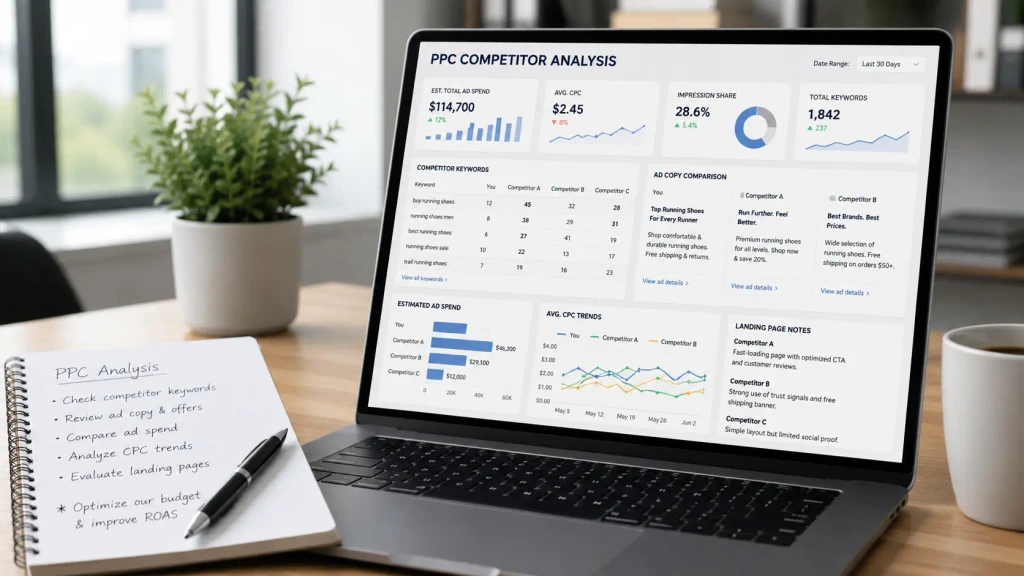
How to Analyze PPC Competitors: A Step-by-Step Guide
A strong PPC competitor analysis does more than show who is bidding on the same keywords. It reveals where competitors invest, which offers they repeat, what landing pages they use, and where they leave opportunities open.
Start by Identifying Your Real PPC Competitors
Your business competitors and PPC competitors are not always the same companies.
A brand may compete directly with you for customers without advertising heavily on Google. At the same time, a publisher, marketplace, comparison website, or company from an adjacent category may consistently compete for your highest-value paid search terms.
Start with the keywords that directly support revenue.
For example, a digital marketing agency could search terms such as:
PPC agency
PPC management services
performance marketing agency
Google Ads agency
paid search agency
Record the advertisers that repeatedly appear across these searches.
Do not build your list from one search. Ads change based on location, device, time, audience, budget, and auction conditions. Look for advertisers that appear consistently across several high-intent terms.
Separate them into three groups:
Direct competitors selling the same service
Indirect competitors solving the same customer problem
Large platforms or marketplaces competing for the same search demand
This gives you a more accurate PPC competitor set.
Analyze Which Keywords Competitors Are Targeting
The next step is understanding where competitors are buying visibility.
SEO tools and PPC intelligence platforms can reveal estimated paid keywords, ad positions, traffic, CPC data, and historical advertising activity.
Focus on patterns rather than collecting every keyword.
Group competitor keywords by search intent.
High-Intent Commercial Keywords
These usually sit closest to conversion.
Examples include:
PPC management company
PPC agency
Google Ads management
paid media agency
hire PPC expert
If several competitors repeatedly bid on the same commercial keyword, that can signal strong customer value.
It does not automatically mean you should bid on it. You still need to evaluate CPC, conversion potential, and expected customer value.
Problem-Based Searches
Competitors may also target users before they search for a specific provider.
Examples include:
reduce Google Ads cost
improve PPC performance
increase ecommerce ROAS
generate more qualified leads
These terms can reveal problems competitors use to enter the customer journey earlier.
Competitor and Brand Searches
Check whether businesses bid on:
Their own brand
Competitor brands
Product names
Alternative searches
Comparison queries
Brand bidding can indicate defensive PPC activity, while competitor targeting can reveal aggressive acquisition strategies.
Use Search Results to Study Competitor Ads
Do not rely entirely on third-party tools.
Review live search results for your most important queries.
For each competitor ad, document:
Headline structure
Main value proposition
Call to action
Pricing language
Guarantees or risk reducers
Social proof
Promotional offers
Location references
Ad assets
Landing page URL
You are looking for repeated messaging patterns.
If the same competitor repeatedly uses phrases such as "free audit," "book a strategy call," or "increase ROAS," those messages probably play an important role in its acquisition strategy.
Compare this with what other advertisers emphasize.
For example:
Competitor | Main Message | Offer | CTA |
|---|---|---|---|
Competitor A | Reduce wasted ad spend | Free audit | Get Your Audit |
Competitor B | Scale ecommerce revenue | Strategy session | Book a Call |
Competitor C | Google Ads specialists | Case study proof | Learn More |
The point is not to copy the best-performing message.
Identify which customer problems dominate the market and where competitors all say the same thing.
That similarity creates positioning opportunities.
Look for Gaps in Competitor Ad Messaging
Competitor research becomes useful when it changes your decisions.
Suppose five agencies advertise on the same keyword.
Four emphasize:
Years of experience
Number of clients
Google Ads expertise
Free consultation
None mentions:
Profitability
New customer acquisition
Contribution margin
First-party measurement
Incremental revenue
That gap gives you something to test.
You can position the campaign around a commercial outcome competitors are not addressing clearly.
Analyze repetition first, then identify what is missing.
How Much Are My Competitors Spending on PPC?
You usually cannot determine an exact competitor advertising budget.
Google does not publicly disclose normal commercial advertisers' full Google Ads spend. Most competitive intelligence platforms therefore provide estimates based on observed keywords, CPC data, positions, traffic models, and historical activity.
Treat these figures as directional rather than exact.
You can estimate competitor PPC investment using several signals.
Estimated Paid Traffic
A competitor attracting significantly more estimated paid search traffic probably runs a larger campaign or performs strongly across high-volume terms.
Traffic alone does not reveal spend because CPCs vary considerably.
Number of Paid Keywords
Track how many commercial keywords the competitor appears to target.
A business bidding consistently across hundreds or thousands of queries likely operates a broader paid search program than one appearing for a small keyword set.
But keyword count can also be misleading.
Ten expensive commercial keywords may require more budget than hundreds of low-CPC terms.
Average CPC
Combine estimated traffic with CPC levels.
A simple directional calculation is:
Estimated monthly paid clicks × estimated average CPC = estimated search spend
If a competitor appears to receive 8,000 paid clicks per month and the relevant CPC averages $6, the rough estimate would be:
8,000 × $6 = $48,000
This is not the competitor's verified budget.
Actual spend can differ because of bidding strategies, match types, quality signals, audience adjustments, campaign limits, and differences between estimated and real click volumes.
Use the estimate to compare competitor scale, not to claim an exact figure.
Use Google Ads Auction Insights When You Have Campaign Data
If you already run Google Ads campaigns, Auction Insights provides useful competitive data based on the same auctions your account enters.
Depending on campaign type, you can review metrics such as:
Impression share
Overlap rate
Position above rate
Top of page rate
Absolute top of page rate
Outranking share
These metrics answer questions that third-party tools cannot answer as directly.
For example, a high overlap rate shows that you frequently enter the same auctions as another advertiser.
A competitor with high impression share and high top-of-page presence may be investing aggressively in that keyword group.
Auction Insights still does not reveal the competitor's budget.
It tells you how strongly that advertiser competes against you.
Track Competitor Activity Over Time
A one-day snapshot can produce poor conclusions.
Competitors change:
Budgets
Campaigns
Landing pages
Offers
Keyword targets
Ad copy
Geographic focus
Track important competitors monthly or quarterly.
Create a simple competitor log containing:
Area | What to Track |
|---|---|
Keywords | New and removed paid keywords |
Visibility | Estimated paid traffic and impression presence |
Messaging | Changes in headlines and offers |
Landing pages | New pages and conversion paths |
Promotions | Discounts, audits, trials, consultations |
Channels | Search, display, paid social |
Positioning | Main commercial promise |
Historical changes often tell you more than a current snapshot.
If a competitor has advertised one landing page and one offer consistently for a year, that is a stronger signal than an ad that appeared for several days.
Analyze Competitor Landing Pages
Do not stop at the ad.
Click through and analyze what happens after the user reaches the website.
Review:
Headline
Message match
Offer
CTA
Form length
Pricing
Testimonials
Case studies
Trust signals
Page speed
Mobile experience
Navigation
FAQs
Objection handling
The relationship between the ad and landing page matters.
If an ad promises a "Free PPC Audit" and the landing page immediately offers the same audit with a short form, the conversion path stays consistent.
If the ad promotes one benefit but sends visitors to a generic service page, the journey creates friction.
This is where PPC competitor analysis overlaps with conversion rate optimization. Competitors may buy the same traffic, but the business with the stronger conversion path can afford to bid more aggressively.
Compare Competitor Offers, Not Just Ads
PPC performance often depends on the offer more than small differences in headline wording.
Document what competitors ask users to do.
Common B2B offers include:
Request a quote
Book a consultation
Get a free audit
Schedule a demo
Download a report
Start a free trial
Request a strategy session
Then compare the level of commitment required.
A "Book a 60-Minute Consultation" offer creates more friction than "Get a Free Account Audit."
That does not automatically make the second offer better. Lead quality may differ significantly.
Your analysis should answer:
What does the user receive?
How quickly do they receive it?
How much information must they provide?
What commitment does the CTA require?
What proof supports the offer?
This helps explain why two advertisers targeting the same keyword may produce very different conversion rates.
Analyze the Entire PPC Funnel
A competitor can run strong ads and still have a weak acquisition system.
Map the full journey:
Keyword → Ad → Landing Page → Offer → Form → Follow-Up → Sale
Look for weaknesses at every stage.
For example:
Strong ad but generic landing page
Strong landing page but long form
Competitive offer but little proof
Good lead generation but unclear next step
Competitor analysis should help you build a better funnel, not just a better advertisement.
Businesses that want to connect campaign execution with acquisition economics can use a structured performance marketing approach rather than optimizing campaigns around clicks alone.
Compare Competitor PPC With Organic Search
Search results often contain paid and organic competitors at the same time.
Analyze both.
A competitor may rank organically for a high-value keyword and also run PPC ads for it. This can give the brand multiple positions on the search results page.
Another competitor may rely almost entirely on paid traffic because it has weak organic visibility.
These two businesses face different acquisition economics.
When you compare SEO vs PPC, look at where competitors already own organic visibility before deciding how aggressively to bid.
For example, if you already rank first organically for a commercial keyword, you can test whether an additional paid position produces incremental conversions.
If you have no organic visibility, PPC may provide immediate access to that demand while SEO develops.
Analyze Competitor ROAS Signals Carefully
You cannot see a competitor's real ROAS unless the company shares it.
You can still assess signals that influence return.
Look at:
Estimated CPC
Offer strength
Landing page quality
Product pricing
Average order value
Repeat purchase potential
Funnel complexity
Customer value
A competitor paying $15 per click may appear aggressive, but that CPC could make sense if one customer produces thousands of dollars in revenue.
This is why competitive CPC analysis without unit economics provides limited value.
If you need to evaluate your own paid media efficiency first, understanding what is ROAS gives you a better baseline for deciding how much you can afford to pay for the same auctions.
Find Keywords Competitors Are Missing
Competitor research should identify opportunities, not only crowded terms.
Compare competitor keyword sets and find:
High-intent terms with limited competition
Long-tail service queries
Industry-specific searches
Location-specific searches
Alternative and comparison queries
Problem-based commercial searches
For example, a general keyword such as:
PPC agency
may have strong competition.
A more specific query such as:
PPC agency for SaaS companies
could have lower search volume but much stronger commercial relevance for the right business.
Keyword gaps can produce better results than simply entering the most competitive auctions.
Compare PPC Activity by Location
Competitors rarely distribute budgets evenly across every market.
Check whether they advertise differently by:
Country
City
Language
Region
A competitor may dominate one geography while having little presence elsewhere.
This creates expansion opportunities.
It can also reveal where the competitor believes customer acquisition economics work best.
For international campaigns, compare:
CPC
Competition
Localized ad copy
Landing page language
Local offers
Conversion rates
Do not assume the market with the most search volume deserves the most budget.
Review Paid Social Competitors Too
PPC competitor analysis should not stop with Google Search.
If the audience uses Meta, LinkedIn, TikTok, or other paid platforms, review competitor activity there as well.
Analyze:
Creative format
Opening hooks
Offers
Video length
Ad frequency
Landing pages
Social proof
Customer pain points
Creative refresh patterns
Search ads usually capture existing demand.
Paid social can show you how competitors create or influence demand before people search.
Together, these signals provide a more complete view of the acquisition strategy.
Build a Competitor PPC Scorecard
Turn research into a repeatable scorecard.
Rate each major competitor across areas such as:
Area | Questions to Answer |
|---|---|
Search visibility | How consistently do they appear? |
Keyword coverage | Which high-intent terms do they target? |
Ad messaging | What value propositions do they repeat? |
Offer | What action do they want users to take? |
Landing page | How closely does it match the ad? |
Proof | Do they use reviews, clients, or case studies? |
Conversion path | How much friction exists? |
Estimated investment | How broad and consistent is paid activity? |
Organic presence | Do they also rank for the same queries? |
Differentiation | What important message are they missing? |
Do not rank competitors using vanity metrics.
Prioritize the companies that consistently compete for the same customers and search intent.
Turn Competitor Data Into PPC Decisions
Competitor research has little value if it ends in a spreadsheet.
Translate findings into campaign decisions.
Your analysis should produce specific actions such as:
Add five high-intent keywords competitors consistently target
Exclude irrelevant terms competitors waste money on
Test a stronger commercial offer
Build a dedicated landing page for a high-value keyword cluster
Rewrite ads around an underserved customer problem
Increase bids where competitors show weak coverage
Reduce spend where acquisition economics do not work
Test new geographic markets
Improve landing page conversion before increasing traffic
You also need reliable reporting to know whether these actions improve performance. A structured data & advanced reporting setup can connect campaign data with leads, revenue, ROAS, and customer acquisition outcomes instead of measuring competitor activity in isolation.
How Often Should You Analyze PPC Competitors?
Review core competitors regularly, but do not react to every small change.
A practical structure is:
Weekly: Monitor major changes in auctions and priority campaigns.
Monthly: Review keywords, messaging, offers, and landing pages.
Quarterly: Reassess the competitor set, market opportunities, channel mix, and budget strategy.
Major product launches, seasonal periods, geographic expansion, and sudden CPC increases also justify additional analysis.
The objective is not to copy competitors faster.
It is to understand how the auction changes before making budget decisions.
What a Useful PPC Competitor Analysis Should Tell You
By the end of the analysis, you should be able to answer:
Who actually competes with us in paid search?
Which commercial keywords matter most to them?
Which keywords are they ignoring?
What messages and offers do they repeat?
How strong are their landing pages?
Where are they likely investing most heavily?
Which markets appear most competitive?
Where can we differentiate?
Which competitor tactics are worth testing?
Which tactics would not make sense for our economics?
If your competitor research cannot answer these questions, you have collected data without turning it into strategy.
Turnalar uses competitor, search, conversion, and performance data together to identify where brands can compete efficiently rather than simply increasing ad spend because competitors appear more aggressive.
About author
Eren turns performance data into smarter growth decisions. He blends paid media, testing, and strategy to help brands scale efficiently, uncover new opportunities, and get more from every campaign.

Eren Korkmaz
Head of Growth
Subscribe to our newsletter
Sign up to get the most recent blog articles in your email every week.